RYPL data for July to September 2026, from comments on advertisers' Facebook and Instagram ads and posts. Of the comments RYPL's AI analyzed, 40% are questions, and 38% show buying intent, mostly questions about the product (the price, availability, specs or how to get it); only 2% say directly that they want to buy. 18% are negative, and 3% accuse the brand of a scam. Banned-word lists remove about 5% of comments, and under 1% of the rest is spam. 70% of comments are not in English.
This report covers the comments people left on the Facebook and Instagram ads and organic posts of advertisers who use RYPL, from July to September 2026. RYPL's AI labeled each comment when it arrived: what the person wants, the tone and the language.
All figures are percentages. Unless a figure says otherwise, it is a share of the comments RYPL's AI analyzed: every comment except the ones that advertisers' banned-word lists removed first. For the comment mix we give two numbers: the share of analyzed comments, and the median advertiser. The median is closer to what a single brand sees, because a few large advertisers account for a lot of the volume. The methodology is at the end of the page.
Key findings
- 40% of comments are questions. 38% show buying intent: they ask about the product (the price, availability, specs or how to get it) or say they want to buy.
- Only 2% of comments say directly that the person wants to buy, such as "I want one" or "how do I order". Most purchase intent comes as a question.
- Buying-intent comments are about twice as common as praise: 38% and 18%.
- 18% of comments are negative in tone. At the median advertiser, complaints and negative remarks make up 22% of comments.
- 3% of comments, about one in 40, accuse the brand of a scam or say the product is fake.
- Banned-word lists removed about 5% of all comments before the AI read them. Under 1% of the analyzed comments were spam.
- 70% of comments are not in English. About 4 in 5 advertisers get comments in two or more languages.
What people write in ad comments
Each comment is counted once, in the first category that applies. The order is listed under the table. The first row is buying intent: a question about the product (the price, availability, specs or how to get it) or a statement that the person wants to buy.
| Comment type | Share of analyzed comments | Median advertiser |
|---|---|---|
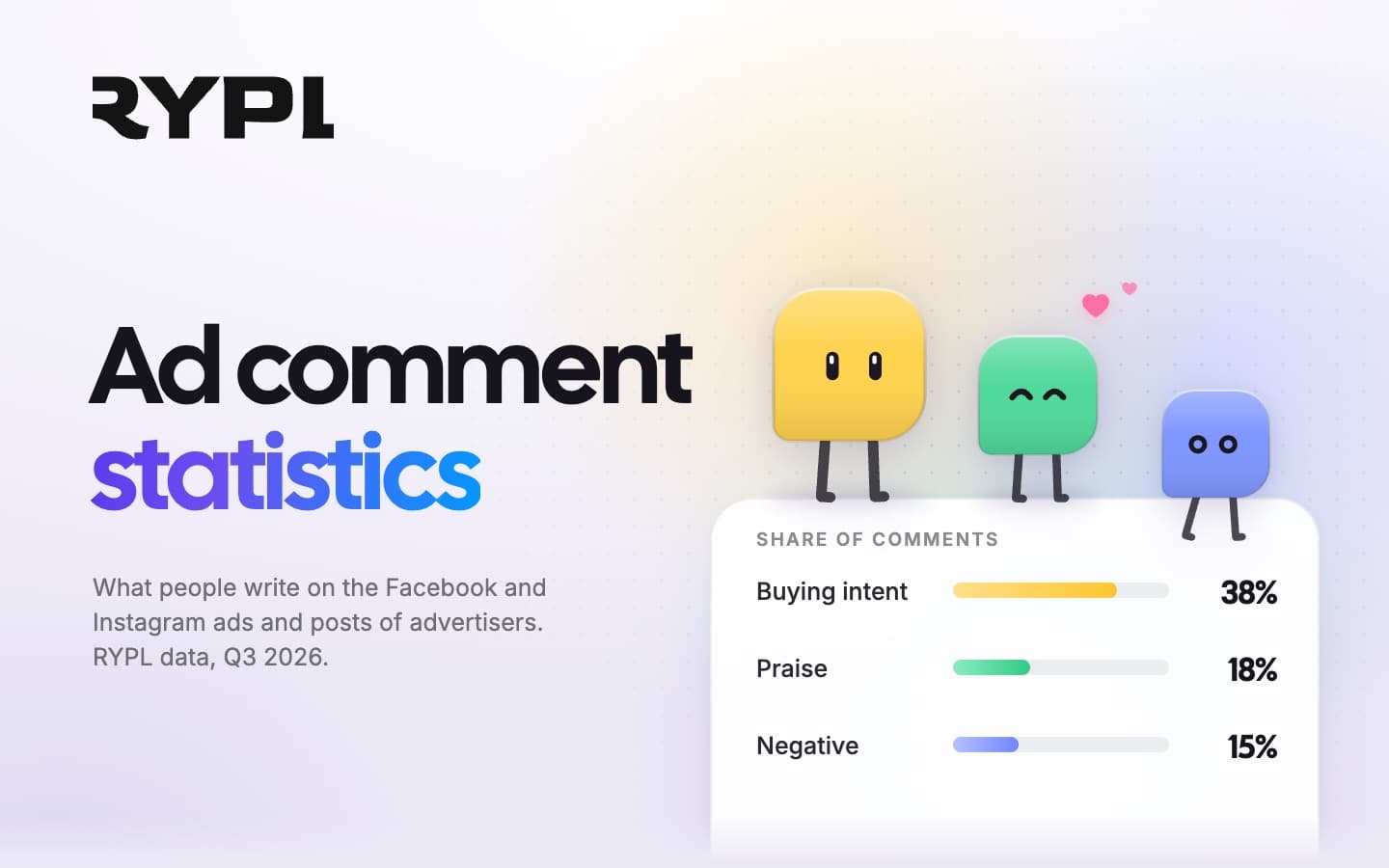
| Question about the product, or wants to buy | 38% | 10% |
| Praise or another positive remark | 18% | 6% |
| Complaint or negative remark | 15% | 22% |
| Emoji only | 8% | 2% |
| Service request (refund, return, order status) | 3% | 1% |
| Toxic (profanity in a negative comment) | 2% | 3% |
| Reply to another commenter | 1% | 0% |
| Spam (links, self-promotion, bot text) | under 1% | under 1% |
| Other (greetings, neutral remarks) | 15% | 20% |
Categories are assigned in this order: spam, toxic, buying intent, service request, complaint or negative remark, reply to another commenter, emoji only, praise, other. Each median is calculated separately, so the median column doesn't add up to 100%.
The two columns differ because the mix varies a lot from one advertiser to another. Buying-intent comments are 38% of analyzed comments but 10% at the median advertiser. Negative comments go the other way: 15% of analyzed comments and 22% at the median.
Labels that overlap
Some labels can apply to the same comment at once. These are shares of analyzed comments:
| Label | Share of analyzed comments |
|---|---|
| Question (with or without a question mark) | 40% |
| Buying intent, as the main or a secondary intent | 39% |
| Says directly they want to buy | 2% |
| Positive tone | 24% |
| Neutral tone | 57% |
| Negative tone | 18% |
| Accuses the brand of a scam or says the product is fake | 3% |
| Sarcasm | 2% |
Negative tone (18%) is higher than the complaint row in the first table (15%) because the first table counts each comment only once. An angry "Where is my order?" counts there as buying intent or a service request, and an abusive comment counts as toxic.
Negative comments and scam claims
18% of the comments the AI analyzed are negative in tone, against under 1% that are spam, and 3% accuse the brand of a scam or say the product is fake. Until it is answered or hidden, a scam accusation under an ad is visible to everyone who opens the comments, whether it is true or not.
Some negative comments need a public reply. A customer whose order is late is one example, because other buyers see how the brand responds. Abuse and false accusations can be hidden. Our guide on how to respond to negative comments on Facebook explains which comments to answer and which to hide, with reply examples.
Spam
Under 1% of the comments the AI analyzed were spam. Advertisers' banned-word lists had already removed about 5% of all comments before the AI saw them. Those comments were not analyzed, so we can't say how many of them were spam. A banned-word list catches comments that use the listed words, and the AI catches spam by what it says, including spam that avoids those words. For the Instagram settings, see how to stop spam comments on Instagram.
Languages
70% of comments were not in English. Comments with only emoji are counted as English, and without them the figure is 76%. About 4 in 5 advertisers got comments in at least two languages, counting a language only when it made up a meaningful share of their comments. About 3 in 10 got comments in three or more.
RYPL's advertisers sell in many countries, so this sample is more multilingual than the comments of a brand that sells only in one English-speaking market. If you advertise in several countries, plan to reply in the language each comment is written in.
How fast comments can be handled
On Facebook, about 7 seconds pass between a comment being posted and RYPL being able to act on it (median). Most of that time is Meta delivering the comment. Tools that use the official API receive comments the same way.
In RYPL's own measurement on Facebook, the median reply went out 17 seconds after the comment was posted, and 97% of replies went out within a minute. Half of the automatically hidden comments were hidden within 13 seconds, and 94% within a minute. These times include Meta's delivery time. When comments are answered by hand, a comment waits until someone next opens the inbox.
What advertisers can do with this
- Answer questions quickly. 4 in 10 comments are questions and only 2% say directly that they want to buy, so most purchase intent is in the questions. See how to detect buying intent in ad comments.
- Decide in advance which negative comments get a public reply, which go to someone on your team and which are hidden. In RYPL, the Filter by tone setting on each channel can hide negative comments automatically or leave them for your agent and your team.
- Reply in the language the comment is written in. Most comments in this data are not in English.
- Keep a banned-word list. It removes comments with the words you list before anything else runs.
RYPL does this for Facebook, Instagram and TikTok ads from one dashboard. It answers questions from your knowledge base in the commenter's language and hides spam and negativity within seconds. See the Facebook comment moderation tool or start a free 7-day trial.
Methodology
- Data. Comments on the Facebook Pages and Instagram accounts that advertisers connected to RYPL, posted from July 1 to September 30, 2026 (UTC). The figures include comments on both ads and organic posts, because our Facebook data doesn't separate the two.
- Excluded. Comments and replies by the brands themselves, and RYPL's internal, test and demo accounts.
- Labels. RYPL's AI labeled each comment once, when it arrived: intent, tone, whether it is a question, language, and flags such as emoji only, profanity or a scam accusation. People did not re-check the labels for this report.
- Banned-word removals. Comments removed by an advertiser's banned-word list never reach the AI. They are counted as a share of all comments and left out of the label shares.
- Median advertiser. Calculated across advertisers with enough comments to measure.
- Publication rule. We publish a figure only if it is based on a minimum number of comments and of different advertisers. Percentages are rounded to whole numbers.
- Languages. The AI detects the language of each comment. Comments with only emoji or numbers count as English.
- Speed. Facebook times start from Meta's comment timestamp, which is rounded to the second. Hide times cover September 7 to 30, 2026. Reply times cover the whole quarter and include any delay an advertiser set in the agent's How soon setting.
- Not covered yet. Types of questions (price, size, shipping), types of spam, and differences between industries.
We plan to update this report every quarter. If you use these figures, please link to this page and credit "RYPL data, Q3 2026".