Deleting removes a comment from the post for everyone, including its author, and Meta documents no way to restore it. Hiding takes it out of the public thread while leaving it visible to the author, so they are not prompted to post again. The two platforms differ: on Facebook a hidden comment stays visible to its author and their friends, while on Instagram it is visible only to you and the author, who is not told it was hidden. Instagram also keeps hidden comments in the post's comment total. Delete for personal data, brand impersonation and illegal content. Hide for everything else, including spam and abuse, because hiding is reversible and deleting is not.
The Delete option sits one line above Hide in the same menu, and most people reach for it first. It is the more aggressive of the two and the only one you cannot take back, which makes the choice worth thirty seconds of thought. This covers what each action actually does on Facebook and on Instagram, where the two platforms behave differently, and which of the two to use on the comments you are most likely to want gone.
What happens when you delete a comment on Facebook?
Deleting takes the comment off the post for everyone. Meta's help text for Pages puts it plainly: when you delete a comment on a post on your Page, "the comment is removed from the post". The author loses it too, along with any replies that were attached to it. Meta documents no way to restore a deleted comment, and there is no undo in the comment menu.
Anyone with a Page role that allows content moderation can delete any comment on that Page's posts, not only their own. On your personal profile's posts you have the same control over comments other people leave.
Two consequences are easy to miss. First, deletion is visible to the author in the only way that matters: they can go back to the post and see their comment is gone. People who write a comment hoping for a reaction tend to check. Second, deleting closes the softer door behind you. In our own integration work with Meta's API, a hide request on a comment that has already been deleted is refused outright, because there is nothing left to hide. Once you delete, hiding is no longer an option you can fall back on.
What hiding does instead on Facebook
Hiding removes the comment from the public thread while leaving it where its author can still see it. Meta's wording: a hidden comment "is still visible to the person who wrote it and their friends". Replies to the comment are hidden along with it, and you can hide only the replies if you want the original to stay public.
Unhiding is available at any time. Under the comment you get an Unhide option, and the Page's hidden comments are listed under the comment sort filter as Hidden from this Page — a view Meta notes is currently available only on a computer or in the Facebook app for Android. Nothing about hiding is permanent.
For spam, that asymmetry is the whole point. The spammer sees their comment sitting on your ad exactly where they left it, so there is no signal to come back with a new account. The full set of ways to hide, including Meta's own Moderation Assist rules, is in how to hide comments on Facebook ads automatically.
How Instagram differs from Facebook
Instagram hides more thoroughly than Facebook does, and the difference matters when you are deciding which platform needs which action.
| Who sees a hidden comment | The author and their friends | Only you and the author |
| Is the author told | Meta documents no notification | Meta states the author "can't see that you hid the comment" |
| Hidden comment in the comment count | Not documented | Still counted in the post's total |
| Where hidden comments are listed | Comment sort filter, Hidden from this Page (computer and Android app) | No equivalent list for manual hides |
| Pre-moderation by person | No equivalent | Restrict: that person's comments wait for your approval |
| Rule-based filtering | Moderation Assist, Page content moderation | Hidden Words: words, phrases, numbers, emoji, plus Instagram's own filter |
Three of those rows are worth acting on. A hidden Instagram comment is sealed off from the author's friends as well as from everyone else, so hiding on Instagram does what most people assume deleting does. The author is explicitly not told, which Meta documents for Instagram and not for Facebook. And because hidden comments still count toward the post's total, the comment number on an Instagram post will not match what a visitor can read, which is normal rather than a bug.
Restrict has no Facebook counterpart and is underused. It targets one account rather than one comment: their future comments on your posts become visible only to them until you approve each one. For a single person who keeps turning up, it is the tool that fits, and it works without blocking them or deleting anything. To delete on Instagram, open the comment, swipe left in the app or hover on the web, then choose Delete from the options menu.
Should you delete or hide a comment?
Hide by default. Delete only when the content of the comment is itself the problem, rather than the opinion it carries.
| Comment | Action | Why |
|---|---|---|
| Spam, scam links, follower-selling | Hide | The author is not prompted to try again with a new account |
| Abuse and profanity aimed at you or a customer | Hide, and ban the account if it repeats | Reversible, and the Page keeps a record |
| A complaint or a bad review | Reply, then hide only if it turns abusive | 51% of public complainers want a public acknowledgement first (Sprout Social) |
| "This is a scam", with no detail | Reply once with the fact that answers it, then hide | Deleting it reads as confirmation |
| Someone's phone number, address or order details | Delete | Leaving it up exposes a real person |
| An account impersonating your brand with a "real page" link | Delete, then report | The link is the harm, and hiding leaves it live for the author's friends |
| Illegal content | Delete, then report | Removal is the point |
| A competitor's discount code | Hide | It stays out of the thread and nobody is alerted |
The sharpest practical reason to default to hiding is sequence. A hidden comment can be deleted later. A deleted comment cannot be hidden, cannot be read again, and cannot be restored.
When deleting is the right call
Three cases justify it. Personal data posted in public, where the comment exposes someone's phone number, home address, order number or photo, and hiding would leave it readable by the author's friends on Facebook. Impersonation, where an account copies your brand name and posts a link to a fake page, because that link keeps working for everyone who can still see the comment. And illegal content, where removal is the only acceptable outcome and reporting it to Meta should follow.
One more case applies to a narrower group. Public-sector pages in the United States should be careful with deletion for a different reason: in Lindke v. Freed (US Supreme Court, 15 March 2024) the Court set a two-part test for when a public official's social media activity counts as state action, which can make deleting a constituent's comment a First Amendment problem rather than a moderation choice. Government accounts, public schools and officials' pages should take legal advice on their comment policy rather than copying a brand's.
Why hiding wins for everything else
Deleting criticism costs more than it saves, and there is evidence on both halves of that. Moderation itself helps: in a 2026 working paper, Park and De Freitas ran six studies on automated comment moderation under brand posts and found it causally improved conversion rate, return on ad spend and purchase intention, with the gain holding even when the brand was open about moderating (arXiv 2609.16005, 29 July 2026). The backfire in their work appeared in a narrower case, where platform-flagged removal hit comments aimed at the brand.
Deleting also removes your chance to handle it in public. In the Sprout Social Index 2025, 51% of people who complain publicly want a public acknowledgement before anything else, and 73% say they would buy from a competitor if a brand does not respond on social. BrightLocal's Local Consumer Review Survey 2026 (11 February 2026) found 77% are less likely to choose a business after reading negative reviews, and 89% expect the owner to respond to them. A deleted complaint removes your reply along with the complaint, so the next reader sees neither.
There is also a reputational floor under all of this. Trustpilot's research with Canvas8 in 2020, across more than 6,000 consumers in the US, UK and France, found 62% would stop using a platform they knew censored reviews and 70% called review censorship a serious concern. That study was about review platforms rather than brand Pages, so treat it as the direction of travel rather than a number about Facebook. The direction is consistent: visible moderation of spam and abuse is accepted, and removal of opinion is not.
What unanswered negativity costs a store, a creator or a publisher
Negativity under a paid post is heavier than most people plan for. Respondology's The Business of Comments 2026 (press release, 9 April 2026) reported that 23.5% of comments it processed were negative, that paid social is roughly twice as toxic as organic, that the hide rate on Meta Ads reached 34.1%, and that brands reply to just 3.5% of comments.
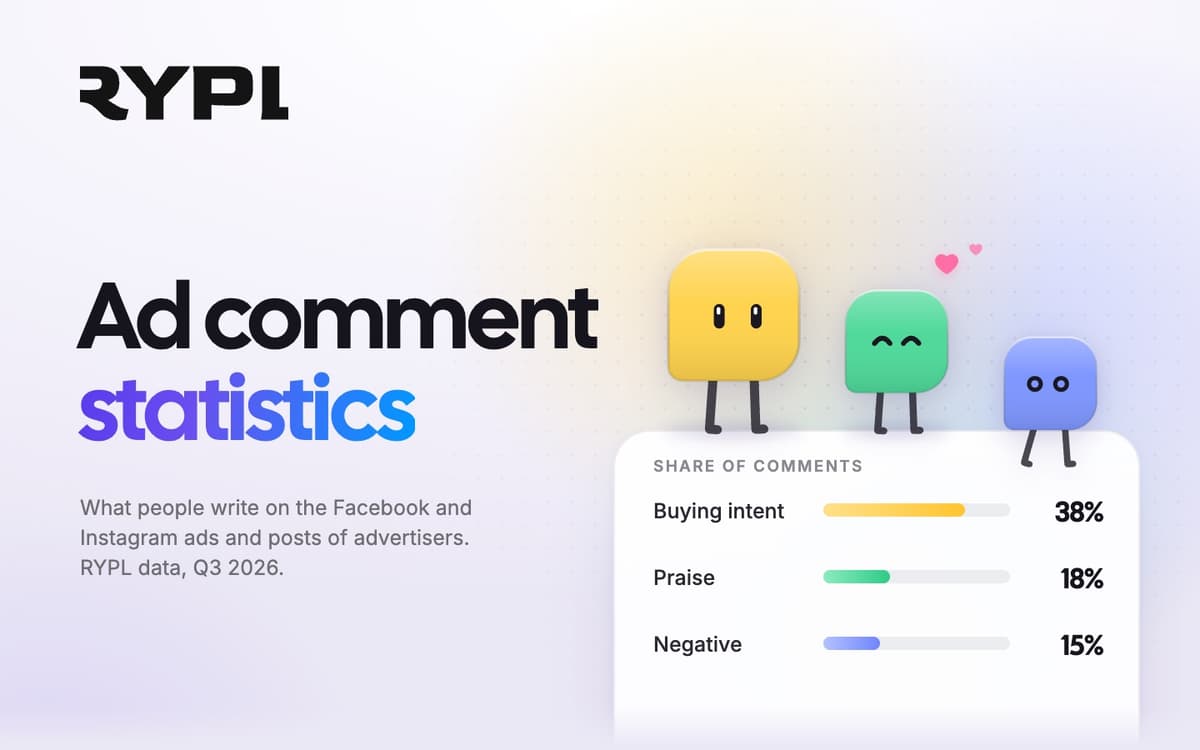
Our own numbers line up on the share. In RYPL's data for July to September 2026, across comments on advertisers' Facebook and Instagram ads and posts, 18% were negative in tone, 15% were complaints or negative remarks, 3% accused the brand of a scam or said the product was fake, and 2% carried profanity in a negative comment. Spam was under 1% once banned-word lists had already removed about 5% of comments. Full method and tables are in ad comment statistics 2026.
What that does next depends on who you are. A store loses the sale in the thread, because a scam accusation sits above the offer for every person who opens the comments and reads it before the product. A creator loses the room, since one unanswered pile-on sets the tone that later commenters match, and sponsors read the comments before they read the media kit. A publisher carries it at the brand level, because an unmoderated comment section reflects on the masthead rather than on the one article that drew it. In all three, the deletions people reach for are the 3% scam accusations and the 15% complaints, which are exactly the comments a reply serves better.
How to handle delete and hide at volume
Doing this by hand holds up until an ad starts working. Two of our measurements explain why. 70% of the comments RYPL analysed were not in English, so reading before deciding is already the bottleneck. And speed decides the outcome: on Facebook, half of the comments RYPL hid automatically were hidden within 13 seconds of being posted and 94% within a minute, with about 7 seconds of that being Meta delivering the comment. A comment handled by hand waits until someone next opens the inbox, by which time the readers who mattered have scrolled past.
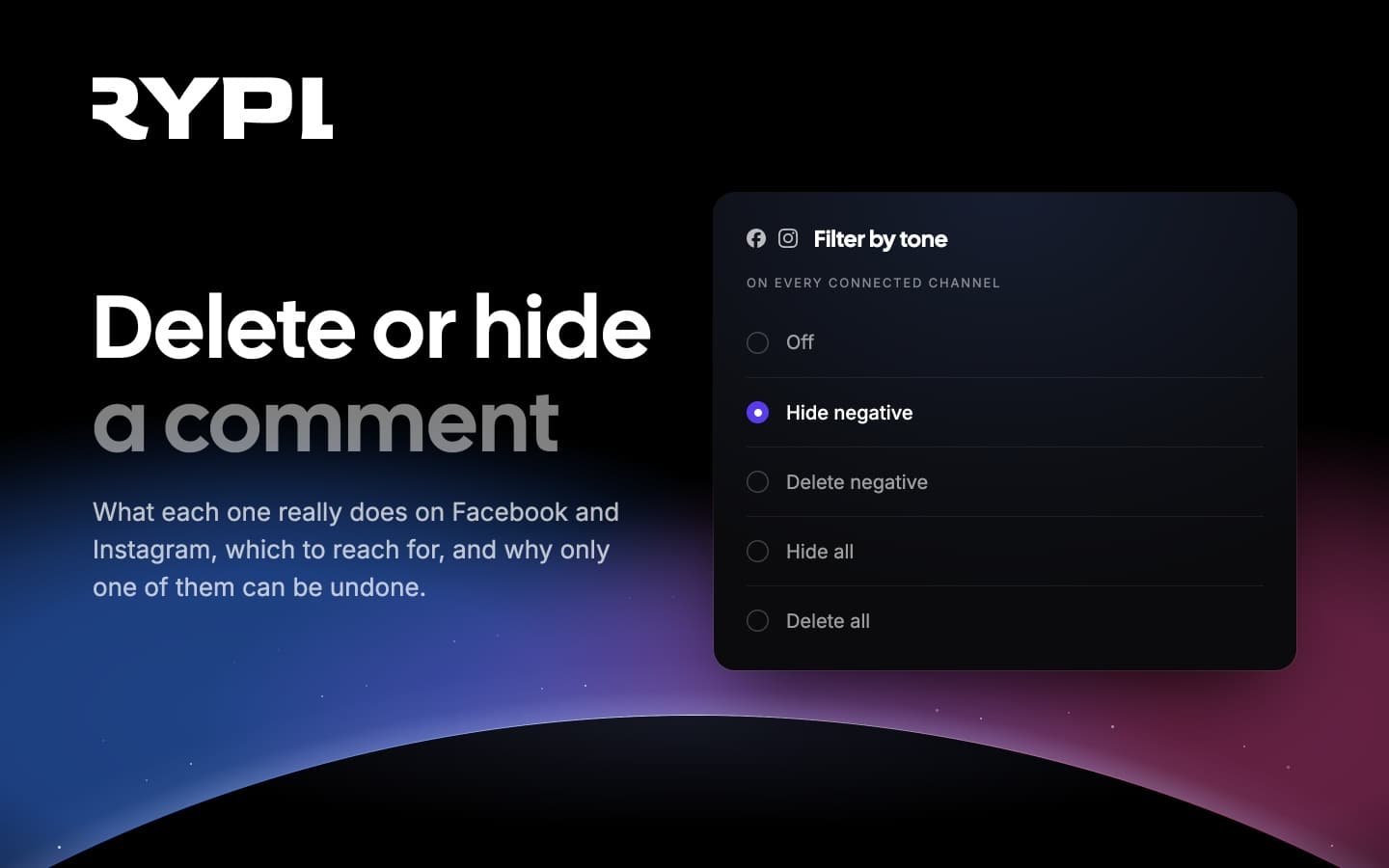
An API tool closes that gap by classifying the comment before choosing an action. Rypl judges a comment in about 1.7 seconds and hides spam and abuse within seconds, answers the price and shipping questions, and routes complaints to a person instead of removing them. Deleting stays available where you want it: the Filter by tone setting on each connected channel offers hide or delete for negative comments, off by default, on every plan. Every automatic hide stays visible in the dashboard and can be undone.
Quick reference
| Question | ||
|---|---|---|
| Delete a comment | Comment menu, Delete | Swipe left or hover, options, Delete |
| Hide a comment | Comment menu, Hide comment | Comment options, Hide |
| Who still sees it hidden | Author and their friends | You and the author only |
| Author told it was hidden | Not documented | No, per Meta |
| Undo a hide | Unhide, or Hidden from this Page (computer, Android) | Unhide from the comment |
| Undo a delete | Not possible | Not possible |
| Filter before it appears | Moderation Assist, content moderation word list | Hidden Words, offensive-content filter |
| Pre-moderate one person | Ban the account | Restrict the account |
For the wider picture of native, rule-based and AI moderation, read Facebook comment moderation in 2026. To see what hiding within seconds looks like on your own ads, start a free 7-day trial: connect a Page and spam on it is hidden within seconds of being posted.