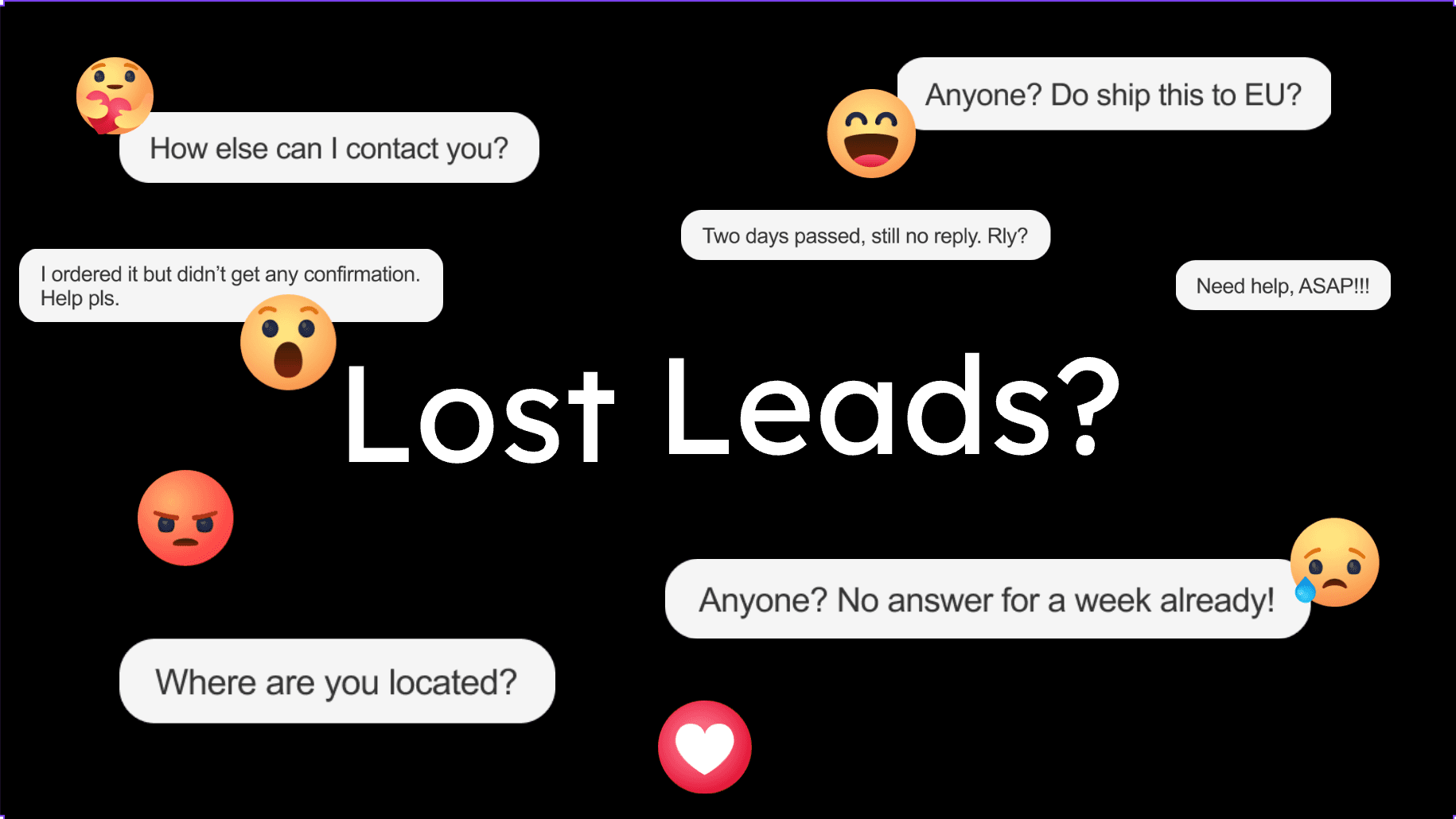
Someone comments "Is this still available?" on your Facebook ad at 9 PM. By the time your team sees it at 9 AM, that person has already bought from a competitor who replied in three minutes. You paid for the impression, the creative, the targeting — and handed the sale to someone else for free.
That is lead leakage: potential customers slipping away not because your product was wrong, but because no one was there to answer. It happens on every ad that generates comments without a response system behind it — and it is silently draining your ROI.
Here is how it works, why it is so hard to fix manually, and how AI finally closes the gap.
The Hidden Reality of Lead Leakage on Facebook
On paper, Facebook is a goldmine for lead generation. It's still the most used social network on Earth, with over 2 billion daily active users, and more than 200 million small businesses rely on it to reach customers.
But here's the uncomfortable truth: most of those conversations never go anywhere.
Research shows that 87% of user posts on Facebook brand pages were ignored. Not every one of those posts needed an answer, but questions about pricing, availability and delivery sit in the same pile, and each one left unanswered is a buyer who heard nothing back. In digital marketing terms, that's not just "missed engagement." That's money leaking through the cracks.
Consumers, meanwhile, have become impatient. According to Edison Research, 42% of consumers who complain on social media expect a reply within an hour. When that doesn't happen, they move on — often straight to a competitor who does respond quickly.
This is the modern version of an unanswered sales call. Only now it happens publicly, in comment sections visible to thousands of potential customers.
Why It Happens (And Why Humans Can't Keep Up)
The main culprit isn't laziness — it's logistics.
Managing Facebook engagement manually is chaos. Comments pour in from boosted posts, ads, and reels. DMs land in multiple inbox folders. Some go to "message requests," others to "spam," some get buried by algorithmic sorting. Notifications are easy to miss. By the time someone notices that "Hey, how much?" comment, the lead has already gone cold.
Add to that:
- 24/7 traffic. People message at midnight, during weekends, and even while you sleep.
- Limited staff. Most small or mid-size teams don't have full-time social media responders.
- No clear process. Comments, messages, and mentions live in different tabs — and often in different apps.
- Cognitive fatigue. Replying manually to repetitive questions ("price?", "how long shipping?") drains focus from high-value leads.
Even big brands struggle. Response rates across verified business pages hover below 20%. The reason is simple — humans can't match the speed or volume of social interactions anymore.
The Real Cost: Missed Revenue and Wasted Ad Spend
Every unanswered message represents a cost you've already paid.
You paid for the ad impression that brought that person to your page. You paid for the content that sparked their curiosity. You paid for your team's time managing campaigns.
Then — silence.
That's how lead leakage quietly eats marketing ROI. A user asks a question on your Facebook ad: "Can I get this in red?" If nobody replies within hours, that sale is gone. Not only that — the algorithm sees low interaction and reduces your ad's reach. Unreplied comments literally make your future ads more expensive.
Replying pays off in measurable ways: in a controlled A/B test at MindValley, adding comment management as the only variable delivered +48% ROAS (details in our Meta ROAS breakdown).
In contrast, ignoring leads has a compounding effect: fewer replies → less trust → less engagement → worse performance → even fewer leads. It's a downward spiral that most businesses don't even notice until someone asks, "Why are sales down when engagement is up?"
Automation as the Plug: How AI Stops the Leak
Here's where AI steps in — not as a gimmick, but as a practical repair tool for a broken workflow.
Comments and DMs Answered in Under a Minute
AI doesn't sleep, doesn't scroll, doesn't forget. With a tool like Rypl, the questions in your comments and DMs get a personalized reply, usually in under a minute. A user writes "How much?" on your ad — the AI responds politely, provides the price, and invites them to DM for more info. Someone messages "Is this available in LA?" — they get a yes and the delivery time from your knowledge base.
Response time drops from hours to seconds. That's how you turn a "maybe later" into a "let's buy now."
Smart Triage
Not all comments are equal. "Nice post" isn't the same as "Where can I order?" Rypl's AI understands intent and filters conversations accordingly. It can:
- Detect purchase intent
- Highlight urgent questions
- Hide spam or toxic replies automatically
- Send complaints and urgent questions to a person
This triage means your team spends its time on the comments that need a person.
24/7 Brand Voice Consistency
One of the most underrated features of AI automation is tone control. Rypl lets you set your AI agent's brand voice — friendly, professional, playful, or persuasive — so replies sound like you, even at 3 a.m.
Consistency builds trust. A brand that answers fast and sounds human earns credibility — and credibility converts.
Questions That Tell You What Buyers Want
Unlike manual replies lost in Messenger threads, Rypl keeps every conversation in one inbox, with the intent behind each comment. The questions that keep repeating are worth feeding back into your ad copy and your knowledge base.
Scaling Without Hiring
Hiring round-the-clock staff is expensive. Training them takes time. Turnover happens. Rypl solves that by acting as your first-line engagement layer — handling routine inquiries while your human team focuses on complex ones.
In essence, it's a full-time community manager that costs less than one Facebook campaign. By RYPL's own measurement, teams selling physical products through Facebook ads saw about +10% ROAS in their first month.
What This Means for ROI
Lead leakage is no longer a customer-service issue; it's a growth problem. Every unanswered interaction chips away at your conversion rate, your ad performance, and your reputation.
Here's the math on illustrative numbers:
| Situation | Outcome |
|---|---|
| 100 people comment or DM | 30 have real buying intent |
| 80% go unanswered | 24 leads lost |
| Average order value $50 | $1,200 lost per post/ad cycle |
| Scale to 10 campaigns | ~$12,000 monthly leakage |
Multiply that by a year — and it's clear why many marketers feel like their budget "just disappears."
Automation doesn't just save time. It saves sales.
The Future of Social Engagement Is Real-Time
Social media has shifted from being a marketing channel to being a conversation engine. The businesses that win are not those who post the most — but those who reply the fastest.
AI tools like Rypl don't replace human creativity; they protect it. By taking over repetitive frontline conversations, they give your team more time to plan strategy, create better campaigns, and focus on relationships that actually move revenue.
In practical terms, adopting AI engagement means:
- DMs answered in under a minute, day or night
- Ad comments that get a reply instead of silence
- Fewer wasted leads
- Fewer silent budget leaks
Stop Optimizing the Wrong Thing
Every marketer talks about conversion optimization. But before you tweak another landing page, look at your comment section.
If you're not replying to the people already asking to buy from you, the problem isn't your funnel. It's the leak before your funnel even starts.
The math is simple: faster replies, fewer missed leads, better ROI on spend you've already committed. Rypl handles the replies automatically — in your voice, at any hour — so the next "Interested!" under your ad doesn't quietly disappear.
Start your free 7-day trial and see how many leads you've been leaving in the comments.