Last updated: October 2026.
A dental clinic pays $76.71 for a Facebook lead. A restaurant pays $3.16. Same platform, same auction, 24× spread. The most-cited stat from the 2025 WordStream/LocaliQ benchmark report is that average Lead-objective CPL hit $27.66, up 21% year over year. That average is also where most media buyers stop reading.
If you optimize your campaigns against the industry blend, you waste budget chasing a number that has nothing to do with your business. This article digs past the headline into the 20-vertical breakdown, the drivers behind the inflation, the lead quality factors most reports skip, and the post-form lever that shifts CPL more than any creative test.
For the broader 2026 cost picture, see our 2026 Facebook Ads benchmarks hub. This article zooms in on lead generation specifically.
The Headline Number, In Context
| Metric | 2024 | 2025 | 2026 (Modeled) |
|---|---|---|---|
| Average Lead-objective CPL (US) | $22.87 | $27.66 | ~$33 |
| Year-over-year change | — | +20.94% | +18–20% |
| Average CPC (Lead objective) | $1.78 | $1.92 | $2.05–$2.15 |
| Average CTR (Lead objective) | 2.43% | 2.59% | 2.45–2.60% |
| Conversion rate (form fill) | 8.67% | 7.72% | 7.5–8.0% |
Sources: WordStream/LocaliQ 2025 benchmark report, SearchEngineLand coverage, Tinuiti Q1 2026 Digital Ads Benchmark Report.
That $27.66 number has three asterisks attached. It's US-only and English-language; global datasets from Superads covering roughly $3B in 2025 ad spend put the global Lead CPL closer to $41.53. It blends Instant Form CPL with conversion-objective CPL, and Lead-form campaigns run 30–50% cheaper at the form-fill stage. And it counts every "lead" as one unit, whether that's a pre-qualified B2B demo request or an Instant Form "Get info" tap.
Use $27.66 as a starting line for your industry-adjusted reading, not as a goal.
CPL by Industry: The Master Table
The most-cited 2025 industry breakdown, with 2026 modeled where actuals aren't yet published. Numbers blend the WordStream/LocaliQ 2025 report with the AdAmigo 2026 Meta CPL benchmarks for industries WordStream doesn't cover at granular depth.
| Industry | 2025 Avg CPL | 2026 Estimate | Notes |
|---|---|---|---|
| Restaurants & Food | $3.16 | $3–6 | Lowest across the dataset |
| Real Estate (form fill) | $16.61 | $18–22 | Qualified buyer leads run 3× higher |
| Career & Employment | $17.64 | $19–21 | High form fill rate |
| Nonprofit | $22.80 | $24–26 | Donor capture |
| Auto Service & Parts | $27.94 | $30 | Repair and aftermarket |
| Retail (general) | $31.95 | $34–38 | Wide variance by sub-category |
| Home Improvement / Services | $34.00 | $35–40 | Plumbing $30–80, roofing $60–120 |
| Education | $34.85 | $36–40 | Online learning is lower; degree programs much higher |
| Healthcare (general) | $41.60 | $45–50 | Excluding dental |
| Auto Dealership | $43.84 | $45–50 | Optimized accounts run $18–32 |
| Beauty & Personal Care | $51.42 | $53–58 | High CPC ($3.06) |
| Health & Fitness | $52.98 | $55–60 | Includes gyms and supplements |
| Finance / Banking / Insurance | $58.70 | $63–70 | Auction-heavy |
| B2B Services / SaaS | $63.40 | $70+ | Qualified leads can hit $150–250 |
| Legal Services | $72.40 | $75–85 | CPC alone is $4.10 |
| Dentists & Dental | $76.71 | $80–90 | +97% YoY in 2025 |
| Travel & Hospitality | $37.20 | $38–42 | Strong ROAS at 12.9× |
| Coaching / Info-products | $30–80 | $35–90 | Highly funnel-dependent |
Three data hygiene notes before you compare yourself to this table. Treat WordStream's dental spike (+97% YoY) as directional: a one-year jump that size can reflect the sample mix. Real Estate shows $16.61 in WordStream and $51.90 in AdAmigo: the difference is funnel stage (raw form fill vs qualified buyer leads). Aggregator sites like Visible Factors and TheeDigital republish WordStream's numbers without attribution; cite WordStream directly when sharing benchmarks with your team or clients.
Industry Deep Dives
Home Services: The 24/7 Cost Trap
Home service ads (plumbing, HVAC, roofing, remodeling) generate leads at an industry average of $34, but the sub-category spread is enormous:
| Sub-category | 2025 CPL Range |
|---|---|
| Plumbing | $30–80 |
| HVAC | $40–80 |
| Roofing | $60–120 |
| Remodeling | $100–200 |
These run hot for two reasons: leads arrive at unpredictable times, and the buyer is already in active urgency. A burst pipe at 11pm on Saturday doesn't wait for business hours. Every off-hours home service lead that goes unanswered is a paid impression that produced nothing. The customer scrolled to the next ad with a faster response.
For high-CPL local service categories, the gap between lead arrival and brand reply is often the difference between a $40 CPL that closes and a $40 CPL that evaporates. We cover the workflow side in our Facebook ad comment management guide and response time analysis.
Legal & Dental: When Auction Density Kills You
Legal Services ($72.40 CPL) and Dental ($76.71 CPL, +97% YoY) sit at the top of the table because a single converted customer is worth thousands in lifetime value. That LTV pulls in well-funded competitors who bid up the audience.
High CPL is sustainable only when your close rate justifies it. A law firm closing 25% of leads at an average case value of $4,000 absorbs a $70 CPL easily. The same firm at 8% close rate on $1,500 cases cannot.
This is where lead leakage compounds. When a prospect comments "Do you handle custody cases?" under a law firm ad and the reply takes 8 hours, they have already messaged the next two firms. For verticals at the top of the CPL table, that leakage is a bigger lever than any creative test. We covered the dynamic in how AI stops Facebook lead leakage.
E-commerce: Where Lead Ads Compete With Conversion Campaigns
E-commerce brands can run lead-style objectives, but most DTC brands run conversion campaigns instead. The relevant comparison isn't "what is my CPL" but "what does my purchase cost look like once I factor in the full funnel."
DTC brands using Lead Ads to build SMS or email lists for retargeting typically see $5–15 CPL. High-AOV categories (furniture, supplements, luxury) can sustain $25–50 Lead Ads because the captured email funnels into long-term retargeting where actual purchase happens 14–60 days later. See our e-commerce Facebook comment automation playbook for the comment-side of this funnel.
B2B SaaS: The Quality Tax
B2B SaaS shows the largest gap between "what Facebook reports" and "what your CRM reports." A $63.40 average CPL sounds attractive until you discover that a large share of those form fills are unqualified (no buying authority, wrong company size, fake-email-for-lead-magnet behavior). Real cost per qualified lead in B2B SaaS is typically several times the reported CPL once the sales team filters the inbox.
The Q4 2025 rollout of SMS verification and work-email validation on Meta Lead Forms was Meta's own response. Even with those controls, B2B advertisers should compare CPL against their CRM-defined SQL cost, not the WordStream blended average.
Lead Ads vs Landing-Page Conversion Campaigns
Ad format affects CPL more than most creative decisions. The trade-off:
| Format | Typical CPL | Lead Quality | Best For |
|---|---|---|---|
| Instant Lead Form (Meta-hosted) | 30–50% lower | Lower close rate (filter happens later) | Low-friction list-building, retargeting fuel |
| Landing-Page Conversion | 20–60% higher | 20–40% higher close rate | High-LTV, complex sales |
| Dual-Destination Lead Ad (new in 2026) | Between the two | Splits audience by intent | Testing intent without two ad sets |
The mental model: Instant Forms minimize friction, landing pages add a click that filters out low-intent traffic. The right format depends on what your sales team can handle downstream. If your close rate on raw Instant Form leads is under 5%, landing pages will produce fewer but better leads at a higher CPL, often improving cost-per-customer.
Meta launched dual-destination Lead Ads in 2026 that route different users to a form or landing page within a single ad set. For accounts with mixed intent in their audience, this can split the trade-off intelligently without running two parallel campaigns.
What Is Driving Facebook CPL Higher
Three forces account for most of the +21% YoY jump. The rest is noise.
Attribution stack collapse. Two changes hit reported conversions hard. iOS 18 privacy controls tightened pixel signal through 2025. On January 12, 2026 Meta removed the 7-day-view and 28-day-view attribution windows from Ads Manager, which dropped reported conversions overnight for considered-purchase categories. DOJO AI's writeup covers the fixes (CAPI plus offline conversions). Real CPL for many accounts is 20–30% below what Ads Manager shows once instrumentation is in place.
Advantage+ adoption inflated auctions, then deflated them. Advantage+ Sales grew from 34% of conversion spend in 2024 to 62% in mid-2025, with Wicked Reports documenting nCAC doubling $257 → $528 in twelve months. By Q1 2026, Tinuiti shows the share fell to 20% as advertisers reclaimed manual control. The auction is rebalancing in 2026, which tempers the inflation.
Q4 2025 holiday squeeze. Gupta Media tracked CPM inflation up to +66% during BFCM. October 2025 Lead CPL peaked at $48.83 (Superads dataset) versus a year-low of $33.43 in March. Lead-gen verticals outside Q4-dependent categories save real money by pulling budget back in October–November and reloading in December–January.
Two smaller drivers worth a mention: Reels inventory expansion (a deflationary force on CPM in 2026) and the 2024 US election spend overhang that bled into Q1 2025 baselines.
The Metric Benchmarks Miss: Post-Form Engagement
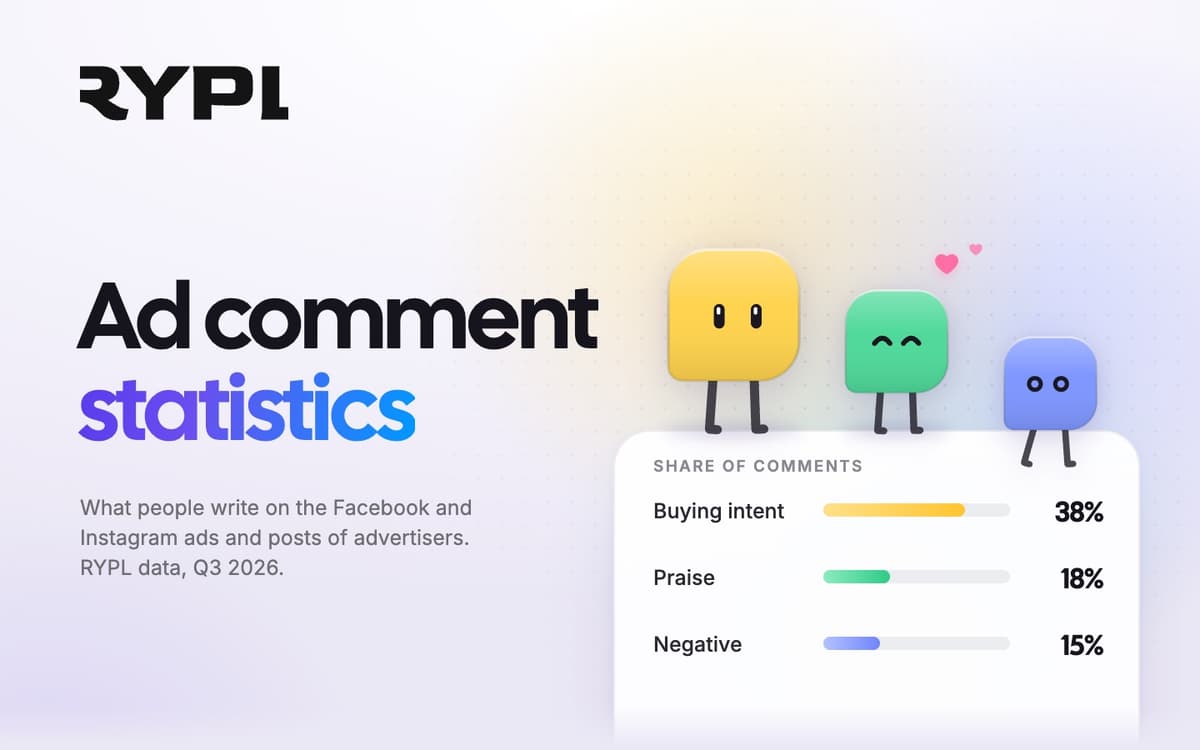
Every CPL benchmark measures one thing: what it costs to make someone submit a form. None measure what happens in the comment section under that lead ad, which is where buying-intent comments quietly compound or evaporate.
Lead ads in high-intent categories (legal, dental, home services, B2B) routinely generate comments like:
- "Do you serve [city]?"
- "How much does this cost?"
- "Can I book a consultation?"
- "What's included?"
These aren't casual engagement. They're qualified leads asking pre-purchase questions in public, next to your form CTA. A reply in minutes turns the entire comment section into social proof for every subsequent viewer. A six-hour silence does the opposite: every other viewer concludes you don't respond.
Meta's own ad relevance diagnostics count comments in your ad's engagement rate ranking, and a prospect who sees questions answered under the ad is more likely to submit the form. An ignored comment section full of unanswered questions works against both.
Creative testing requires new assets and new sample sizes. Comment management is a workflow change that takes effect immediately.
How to Lower Your Facebook CPL in 2026
Six levers, roughly ordered by impact:
-
Connect CRM via Conversions API. Highest-impact change for accounts on incomplete pixel data. Meta's optimization gets sharper, reported CPL stabilizes, real CPL often drops 10–20%.
-
Shift creative testing toward Reels. Reels CPMs run 10–30% below Feed and inventory keeps expanding. Cut Feed-only creatives, double Reels variants.
-
Activate Instant Lead Form spam controls. SMS verification and work-email validation have been available since the Q4 2025 rollout; switch them on. Reported CPL may rise 5–10% on paper while real qualified-lead cost drops sharply.
-
Reduce form fields. Every field beyond 4 drops fill rate ~5%. If sales needs 8 data points, capture 4 in the form and collect the other 4 on the follow-up call.
-
Build a retargeting layer for engaged comment authors. Many accounts see retargeting CPLs as low as $3. Comment engagement is one of the strongest custom-audience signals you can build.
-
Close your comment-reply gap. Pull your top 10 ads from the last 30 days. Count total comments, count replies. If your reply rate is under 50% (the audit norm), the math is straightforward: unanswered buying-intent comments per week × average order value × 10% conversion rate = uncaptured revenue you already paid to generate.
The first five require campaign or creative changes. The sixth is a workflow change that takes effect immediately, which is why it's the cheapest fix to deploy.
What to Run in Your Account This Week
A four-step audit you can complete in 90 minutes.
-
Pull your CPL by ad set for the last 30 days. Compare each line against the industry row in the master table above. Flag anything more than 25% above your industry median.
-
Check your attribution window. If you're still using anything other than 7-day-click or the new default, your reported CPL is artificially high. Switch and re-baseline.
-
Audit your reply rate on lead ads. Open the top 10 ads by spend in the last 30 days. Count comments. Count brand replies. Below 50% reply rate means you're leaving distribution lift on the table.
-
Build the leakage spreadsheet. Unanswered buying-intent comments per week × your AOV × 10% close rate. That number is your monthly comment-leakage cost. Compare it to the monthly cost of fixing the leak.
The comment-reply gap is one of the few CPL fixes you can deploy without touching campaigns. Start a 7-day Rypl trial — AI replies to buying-intent comments in seconds, hides spam within seconds, and covers nights and weekends when your team is offline.