Every quarter, the same benchmark reports make the rounds. CTR by industry. CPC trends. Conversion rates. Cost per lead. Media buyers study these numbers, compare their accounts, and adjust their bid strategies accordingly.
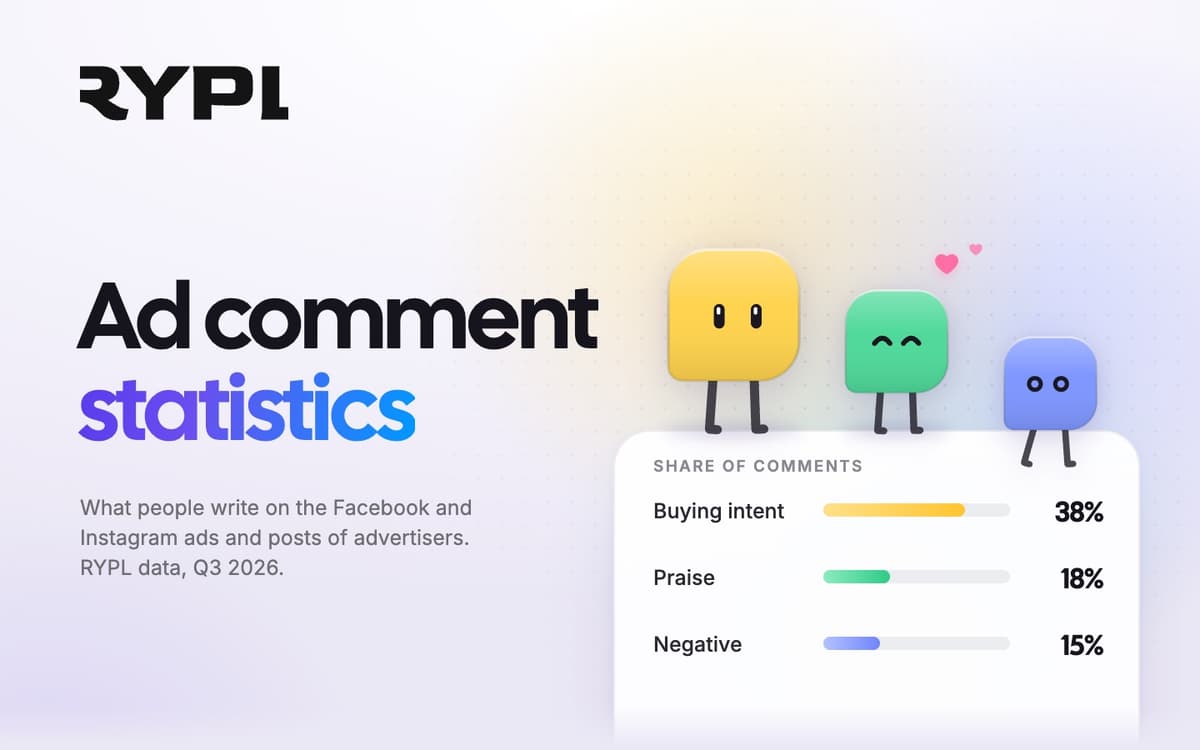
But there is a metric that none of these reports track — and it might be the single highest-leverage variable in your entire ad account: what happens in your comment section after the ad is served.
The 2026 Facebook Ads benchmarks tell a clear story: costs are rising, competition is intensifying, and the margin for error is shrinking. The businesses that outperform these averages are not just running better creatives. They are managing the conversations their ads create. And that distinction is worth more than any bid strategy tweak.
The 2026 Benchmark Landscape
Let's start with the numbers. Based on WordStream/LocaliQ data and TheeDigital's 2026 analysis, here is where Facebook Ads performance stands heading into 2026:
Overall Averages (2025 Actuals)
| Metric | Leads Objective | Traffic Objective |
|---|---|---|
| Click-Through Rate (CTR) | 2.59% | 1.71% |
| Cost Per Click (CPC) | $1.92 | $0.70 |
| Conversion Rate (CVR) | 7.72% | — |
| Cost Per Lead (CPL) | $27.66 | — |
Year-Over-Year Trend (2025 → 2026 Projections)
| Metric | 2025 | 2026 (Est.) | Change |
|---|---|---|---|
| Average CTR | 1.71% | 1.55% | -9.4% |
| Average CPC | $0.70 | $0.78 | +11.4% |
| Average CVR | 7.72% | 8.2% | +6.2% |
| Average CPA | $27.66 | $30.00 | +8.5% |
The pattern is unmistakable: costs are going up faster than conversion rates are improving. CPC rose 11.4%. CPA rose 8.5%. CVR only improved 6.2% — not enough to offset the cost increases. For most advertisers, the net effect is paying more for each customer acquired.
Cost Per Action by Industry: Where You Stand
The gap between industries is enormous. A $55 CPA in Technology versus $8 in Education means that the same optimization mistake costs one advertiser seven times more than another.
| Industry | Cost Per Action |
|---|---|
| Education | $8 |
| Apparel | $11 |
| Healthcare | $12 |
| Fitness | $13 |
| Real Estate | $17 |
| All Industries Average | $19 |
| Retail | $21 |
| Employment & Job Training | $23 |
| Travel & Hospitality | $23 |
| Beauty | $25 |
| Legal | $29 |
| Consumer Services | $31 |
| Industrial Services | $38 |
| Finance & Insurance | $41 |
| Automotive | $44 |
| Home Improvement | $45 |
| Technology | $55 |
If your CPA is above your industry average, the standard advice is to fix your targeting, test new creatives, or optimize your landing page. All valid. But there is a variable hiding in plain sight that most optimization playbooks never mention.
The Metric That Benchmarks Miss: Post-Click Engagement
Every benchmark report measures what happens before someone engages with your ad — impressions, clicks, costs. Almost none measure what happens after — specifically, what happens in your comment section.
This matters because engagement feeds back into how your ads compete:
- More comment replies → more back-and-forth → more engagement signals
- More engagement signals → a better engagement rate ranking against competing ads
- Better engagement and fewer hides → an ad that tends to compete better in the auction
- Fewer replies → dead-end interactions → fewer of those signals
In practical terms: two identical ads with identical targeting and identical creatives will perform differently based solely on whether the brand replies to comments. The ad with active comment engagement gets cheaper distribution. The ad with an ignored comment section gets penalized.
This is not speculation. Meta's own ad relevance diagnostics confirm that engagement rate is a core input to delivery optimization. Your comment section is not a side effect of your ad. It is part of your ad's performance.
Industry Deep Dive: How Comment Management Shifts the Numbers
Let's look at how active comment management could shift the benchmarks for specific industries. The projections below combine TheeDigital's 2026 industry data with engagement impact research from Respondology and Sprout Social.
Law Firms
| Metric | 2025 Actual | 2026 Projected | With Active Comment Mgmt |
|---|---|---|---|
| CTR | 2.11% | 2.0% | 2.0–2.3% |
| CPC | $4.10 | $4.40 | $3.50–$4.00 |
| CPL | $18.17 | $21.00 | $16.00–$19.00 |
| CVR | 10.53% | 10.0% | 11.0–12.5% |
Law firm ads generate high-intent comments: "Do you handle custody cases?", "Free consultation?", "What areas do you serve?" These are not casual engagement — they are qualified leads asking pre-purchase questions in public. An instant, accurate reply converts. A 6-hour silence sends them to the next firm in their feed.
Home Services
| Metric | 2025 Actual | 2026 Projected | With Active Comment Mgmt |
|---|---|---|---|
| CTR | 1.99% | 2.1% | 2.1–2.4% |
| CPC | $2.08 | $2.30 | $1.80–$2.10 |
| CPL | $30.57 | $34.00 | $26.00–$30.00 |
| CVR | 6.51% | 7.0% | 7.5–9.0% |
Home service ads live on trust. When a homeowner sees "How much for a roof inspection?" answered with a specific, helpful reply within minutes, the entire comment section becomes social proof. When that question sits unanswered for 8 hours, every other viewer draws the same conclusion: this company does not respond.
Construction / Metal Buildings
| Metric | 2025 Actual | 2026 Projected | With Active Comment Mgmt |
|---|---|---|---|
| CTR | 1.94–2.08% | 2.0–2.2% | 2.2–2.5% |
| CPC | $1.80–$2.23 | $2.00–$2.45 | $1.60–$2.10 |
| CPL | $37.34–$41.26 | $41–$45 | $32–$38 |
| CVR | 5.22–9.34% | 5.5–9.8% | 6.5–11.0% |
Construction leads are high-ticket. A single $41 lead that converts into a $50,000+ project makes the CPL irrelevant. But a $41 lead that goes cold because nobody answered "Can you build a 40x60 shop?" is pure waste. At these price points, every unanswered comment is not just a missed lead — it is hundreds of dollars in ad spend with no return.
Why "Just Reply Faster" Is Not a Real Strategy
The standard advice for improving post-click engagement is simple: reply to your comments more quickly. In theory, this is correct. In practice, it collapses under the weight of how Facebook ads actually work.
Here is why manual comment management fails at scale:
Volume. A single campaign with 5 ad sets running across 3 placements can generate comments in 15 different places simultaneously. Most teams check their main page feed and miss the comments sitting on dark posts inside Ads Manager.
Hours. According to Sprout Social, the average business response time on Facebook is 4–12 hours. But Edison Research found that 42% of consumers expect a reply within 60 minutes. By the time your team responds, the lead is cold.
Coverage. Your ads run 24/7. Your team does not. Comments arriving at 11pm on Saturday, during holidays, or across time zones go unanswered until Monday morning. By then, you have paid for the impressions and received nothing in return.
Consistency. Even dedicated teams vary in tone, accuracy, and speed. One person replies in 10 minutes with a helpful answer. Another takes 3 hours and sends "Thanks for your interest!" to a pricing question. The algorithm sees the same thing either way: inconsistent engagement.
The math is straightforward. Research published in Harvard Business Review found that companies that tried to contact a lead within an hour were nearly 7x as likely to qualify it as those that waited even an hour longer, and over 60x as likely as those that waited 24 hours or more. On Facebook ads — where users are scrolling through competing content — that window is even shorter.
The AI Layer: Treating Comment Management as a Performance Channel
This is the shift that separates brands beating their industry benchmarks from brands paying above-average CPAs: treating comment management as a performance channel, not a customer service afterthought.
An AI comment management system operates at the speed and scale that benchmarks actually reward:
- Response time: Under 60 seconds vs. 4–12 hours industry average
- Coverage: 24/7/365 — no gaps on evenings, weekends, or holidays
- Reply rate: questions get an answer and complaints go to a person, vs. the typical 15–25% answered manually
- Intent detection: Purchase questions, support requests, and spam each get handled differently
- Moderation: Toxic comments and spam hidden within seconds, not hours later
- Consistency: Same brand voice, same accuracy, every reply
When questions get answered in seconds instead of hours, the comment section starts working for the ad: more engagement, more social proof, and fewer buyers who give up and scroll on.
Based on RYPL's own measurements:
| What Changes | Impact |
|---|---|
| Response time | Under 60 seconds |
| ROAS | About +10% within the first month |
The cost to achieve this with human staff — 3–5 people covering all time zones, weekends, and holidays — runs $150,000–$250,000 per year. An AI system costs less than a single ad campaign and never takes a day off.
How to Use These Benchmarks
Benchmarks are context, not targets. Here is how to make these numbers actionable:
Find your industry baseline first. Look at CPA, CPC, and CVR for your vertical. If you are significantly above average, resist the urge to immediately blame targeting or creative. Check your comment reply rate first — it is often the variable nobody audited.
Calculate your comment gap. Pull your top 10 ads from the last 30 days. Count total comments. Count replies. If your reply rate is below 50%, that gap has a dollar value: unanswered buying-intent comments per week × average order value × 10% conversion rate. That is uncaptured revenue you already paid to generate.
Then compare the cost of the gap to the cost to close it. If the math shows $5,000/month in leaked leads and an AI system costs $49/month, the calculation is not complicated.
Track the before/after. Once you have any comment management system running — manual or AI — measure CPL, CPA, and ROAS for the same campaigns over a 30-day window. The shift is usually visible within the first two weeks, not because the creatives improved, but because the engagement loop started working in your favor.
The Bottom Line
The 2026 Facebook Ads benchmarks are clear: costs are rising, margins are tightening, and the easy optimizations have already been made. Everyone is testing creatives, refining audiences, and tweaking bid strategies. Those levers still matter — but they are table stakes now.
The competitive edge in 2026 is not in the ad itself. It is in what happens after the ad is served. The comment section is where attention turns into conversation and conversation turns into revenue. Right now, most brands are paying for that attention and then ignoring it.
Every unanswered comment is wasted ad spend with a receipt. Every slow reply is a lead your competitor gets instead. The benchmarks will keep going up. The question is whether you are going to keep paying more for the same results — or start converting the engagement you have already paid to generate.
This is exactly the problem that lead leakage creates, and it is why we built Rypl — to close the gap between ad spend and actual revenue.
Start your free 7-day trial and see what your ad comments are actually worth.